
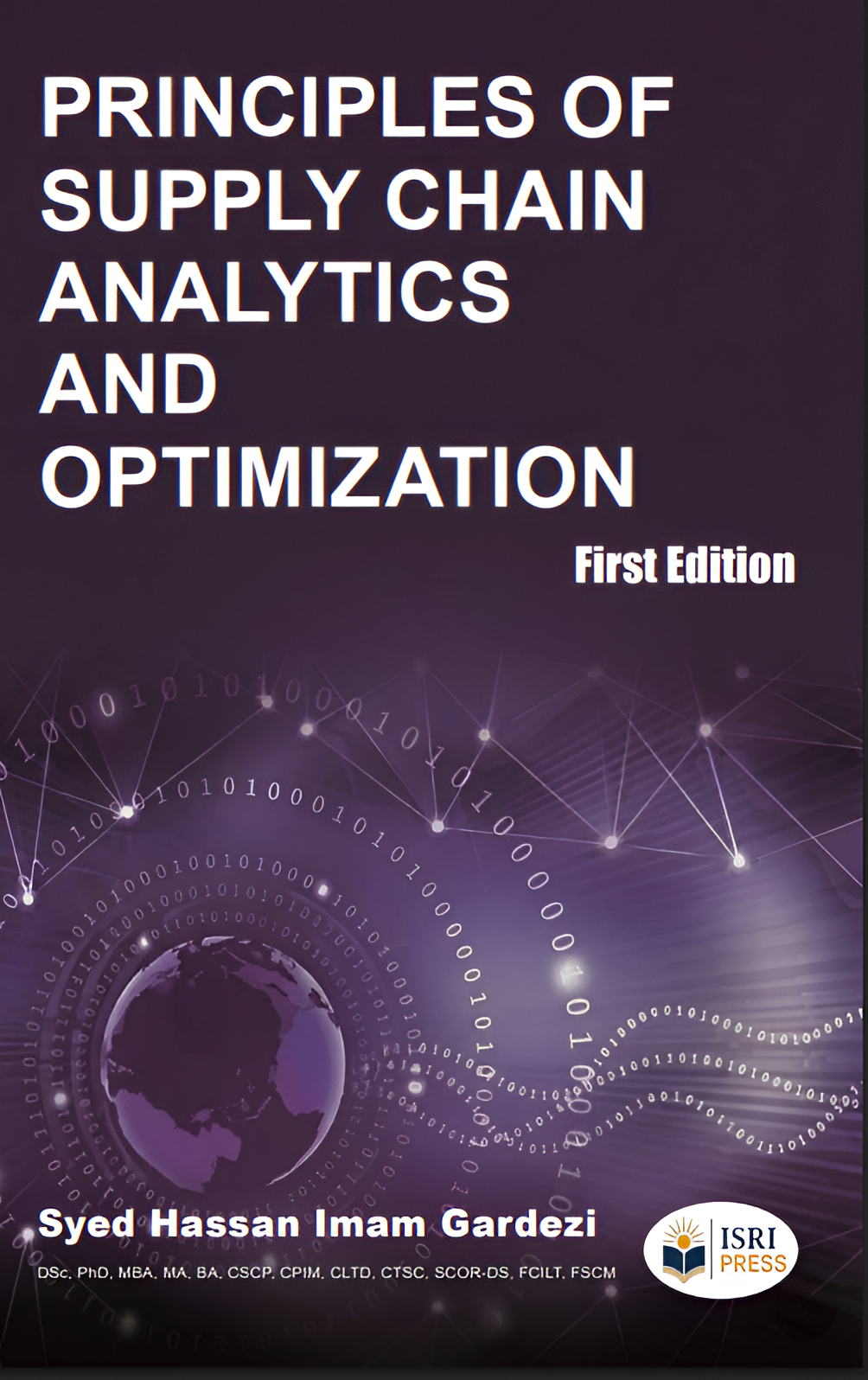
Principles of Supply Chain Analytics and Optimization
About the Book
Supply Chain Analytics and Optimization offers a comprehensive and contemporary exploration of analytical techniques and optimization strategies that drive efficient and resilient supply chains. Designed within a global and data-driven context, the book highlights how analytics transforms traditional supply chain operations into intelligent, adaptive, and performance-oriented systems.
The book begins by establishing foundational concepts of supply chain management, including its evolution, scope, and key drivers. It clearly differentiates between logistics and supply chain functions while emphasizing the growing importance of analytics in decision-making across strategic, tactical, and operational levels.
A major strength of this work lies in its structured coverage of core analytical domains such as demand forecasting, inventory optimization, network design, and transportation planning. It integrates both classical models and modern data-driven approaches, enabling readers to understand variability, uncertainty, and performance measurement in real-world supply chains.
The book further explores advanced optimization techniques including linear programming, simulation models, and metaheuristic algorithms. These approaches are presented alongside practical applications in production planning, capacity management, and logistics optimization, ensuring both theoretical depth and practical relevance.
Special emphasis is placed on emerging technologies such as artificial intelligence, machine learning, big data analytics, Internet of Things (IoT), and blockchain. The integration of these digital tools into supply chain systems is discussed in detail, highlighting their role in enhancing visibility, agility, and resilience in complex global networks.
By combining analytical rigor, technological advancements, and strategic insights, this book serves as a valuable resource for understanding modern supply chain challenges and solutions. It equips readers with the knowledge required to design, analyze, and optimize supply chains in an increasingly dynamic and uncertain environment.
Key Features
- Comprehensive coverage of supply chain analytics and optimization techniques
- Integration of forecasting, inventory, logistics, and network design models
- Application of quantitative methods including linear programming and simulation
- Inclusion of advanced techniques such as genetic algorithms and metaheuristics
- Focus on real-world supply chain challenges and performance measurement
- Detailed discussion on AI, machine learning, IoT, and blockchain in supply chains
- Emphasis on risk management, resilience, and sustainable supply chain practices
Target Audience
This book is intended for management students, engineering students, supply chain professionals, operations managers, researchers, academicians, and industry practitioners. It is particularly useful for those seeking to apply analytical and optimization techniques to improve supply chain efficiency, responsiveness, and decision-making.
Keywords
Keywords: Supply Chain Management, Supply Chain Analytics, Demand Forecasting, Inventory Optimization, Logistics Management, Network Design, Optimization Techniques, Linear Programming, Artificial Intelligence, Machine Learning, IoT, Blockchain, Supply Chain Risk, Digital Supply Chains
Contents
| Chapter 1 | 8 | |
| Introduction to Supply Chain Management | 8 | |
| 1.1 | Evolution and Scope of Supply Chain Management | 9 |
| 1.2 | Supply Chain versus Logistics | 10 |
| 1.3 | Key Supply Chain Drivers and Decision Levels | 12 |
| 1.4 | Role of Analytics in Modern Supply Chains | 14 |
| 1.5 | Supply Chain Performance Challenges in Global Context | 17 |
| Conclusion | 20 | |
| Chapter 2 | 22 | |
| Fundamentals of Supply Chain Analytics | 22 | |
| 2.1 | Types of Analytics: Descriptive, Diagnostic, Predictive, Prescriptive | 23 |
| 2.2 | Data Sources in Supply Chains | 26 |
| 2.3 | Data Quality, Integration, and Governance | 29 |
| 2.4 | Supply Chain Metrics and Key Performance Indicators | 31 |
| 2.5 | Analytical Maturity Models | 34 |
| Conclusion | 37 | |
| Chapter 3 | 39 | |
| Demand Forecasting and Analytics | 39 | |
| 3.1 | Demand Patterns and Variability | 40 |
| 3.2 | Qualitative and Quantitative Forecasting Methods | 41 |
| 3.3 | Time Series Models for Demand Forecasting | 44 |
| 3.4 | Forecast Accuracy Measurement | 46 |
| 3.6 | Integration of Forecasting with Supply Chain Planning | 52 |
| Conclusion | 54 | |
| Chapter 4 | 57 | |
| Inventory Analytics and Optimization | 57 | |
| 4.1 | Inventory Types and Cost Components | 58 |
| 4.2 | Deterministic and Probabilistic Inventory Models | 62 |
| 4.3 | EOQ and Safety Stock Optimization | 65 |
| 4.4 | Multi-Echelon Inventory Systems | 68 |
| 4.5 | Inventory Optimization Using Analytics Tools | 71 |
| Conclusion | 75 | |
| Chapter 5 | 78 | |
| Network Design and Supply Chain Configuration | 78 | |
| 5.1 | Supply Chain Network Structures | 79 |
| 5.2 | Location-Allocation Models | 83 |
| 5.3 | Transportation and Warehousing Trade-offs | 88 |
| 5.4 | Risk and Resilience in Network Design | 93 |
| 5.5 | Optimization Techniques for Network Planning | 97 |
| Conclusion | 102 | |
| Chapter 6 | 105 | |
| Transportation and Logistics Optimization | 105 | |
| 6.1 | Transportation Modes and Cost Analysis | 106 |
| 6.2 | Routing and Scheduling Problems | 110 |
| 6.3 | Vehicle Routing Problem (VRP) Models | 114 |
| 6.4 | Last-Mile Logistics Optimization | 119 |
| 6.5 | Green and Sustainable Logistics Analytics | 123 |
| Conclusion | 129 | |
| Chapter 7 | 132 | |
| Production and Capacity Planning Analytics | 132 | |
| 7.1 | Aggregate Production Planning | 133 |
| 7.2 | Capacity Planning Under Uncertainty | 137 |
| 7.3 | Scheduling Models and Constraints | 142 |
| 7.4 | Lean and Just-In-Time Analytics | 146 |
| 7.5 | Integration of Production and Supply Chain Plans | 151 |
| Conclusion | 155 | |
| Chapter 8 | 157 | |
| Supply Chain Risk Analytics and Resilience | 157 | |
| 8.1 | Sources of Supply Chain Risk | 159 |
| 8.2 | Risk Identification and Assessment Models | 164 |
| 8.3 | Disruption Modeling and Scenario Analysis | 168 |
| 8.4 | Resilient Supply Chain Strategies | 172 |
| 8.5 | Post-Pandemic Supply Chain Lessons | 176 |
| Conclusion | 180 | |
| Chapter 9 | 182 | |
| Optimization Techniques in Supply Chains | 182 | |
| 9.1 | Linear and Integer Programming | 183 |
| 9.2 | Nonlinear and Dynamic Optimization Models | 188 |
| 9.3 | Metaheuristics: Genetic Algorithms, PSO, ACO | 193 |
| 9.4 | Simulation-Based Optimization | 199 |
| 9.5 | Decision Support Systems for Optimization | 203 |
| Conclusion | 208 | |
| Chapter 10 | 210 | |
| Digital and Intelligent Supply Chains | 210 | |
| 10.1 | Role of AI and Machine Learning in Supply Chains | 211 |
| 10.2 | Big Data and Cloud-Based Supply Chain Analytics | 218 |
| 10.3 | IoT, Blockchain, and Visibility Platforms | 223 |
| 10.4 | Industry 4.0 and Smart Supply Chains | 229 |
| 10.5 | Future Research Directions and Global Case Studies | 233 |
| Conclusion | 240 |

Recommended Citation
APA 7th Edition