ISRI Press Header
Journals

Peer-reviewed academic journals across disciplines.

Author Books

Scholarly monographs and edited volumes.

Magazines

Professional and industry-focused publications.

Edited Book Series

Individual academic book chapters.

Explore
Browse All Publications

Explore the complete ISRI Press publication catalogue.

Submit
Submit Manuscript

Online submission for journals and books.

Author Guidelines

Formatting and ethical standards.

Editorial
Editorial Board

Meet our academic editors.

Publication Ethics

Our peer review and integrity policies.

Support
Reviewer Resources

Tools and guidance for peer reviewers.

Members
Author Membership

Benefits for contributing authors.

Editor Membership

Join ISRI editorial leadership.

Partners
Reviewer Membership

Recognition for peer reviewers.

Institutional Membership

University and library partnerships.

Benefits
Membership Benefits

Explore all professional advantages.

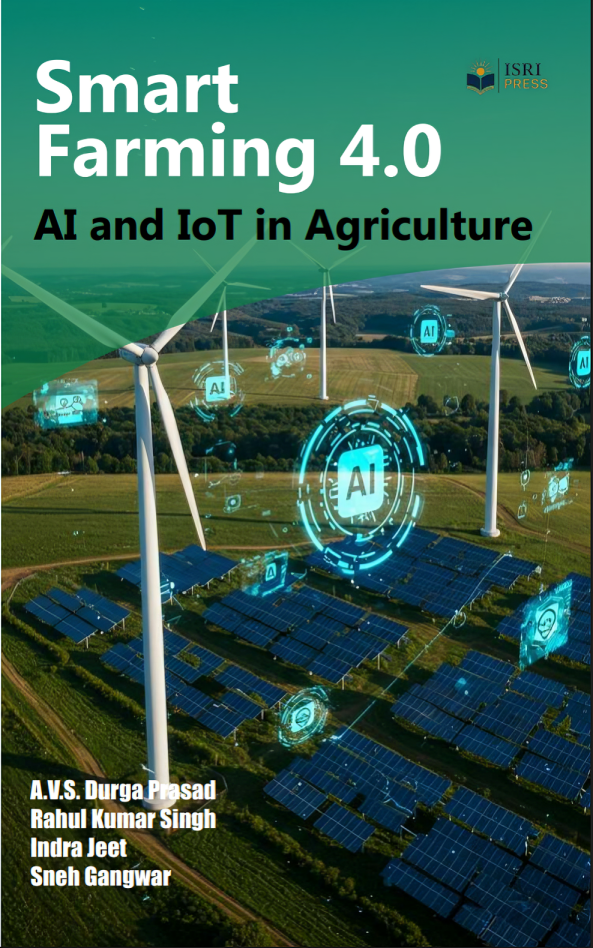
Smart Farming 4.0: AI and IoT in Agriculture

Smart Farming 4.0: AI and IoT in Agriculture

by A. V. S. Durga Prasad iD

A. V. S. Durga Prasad

Professor, Department of Genetics and Plant Breeding, Agricultural College, Bapatla, Acharya N.G. Ranga Agricultural University (ANGRAU), Andhra Pradesh, India.
Rahul Kumar Singh iD

Rahul Kumar Singh

Scientist/SMS (Agricultural Extension), Krishi Vigyan Kendra (KVK), Varanasi, Uttar Pradesh, India
Indra Jeet iD

Indra Jeet

Subject Matter Specialist (Agricultural Extension) ICAR–Research Complex for Eastern Region (ICAR-RCER), Krishi Vigyan Kendra Ramgarh, Jharkhand, India
Sneh Gangwar iD

Sneh Gangwar

Assistant Professor, Department of Geography, Indraprastha College for Women, University of Delhi, Delhi, India
ISBN (Print): 978-93-47486-43-2
ISBN (Online): 978-93-47486-21-0
Published: 2025
Pages: 187
ABOUT THE BOOK
TABLE OF CONTENTS
AUTHOR BIOGRAPHY
CITATION

About the Book

Smart Farming: Technologies and Innovations for Sustainable Agriculture provides a comprehensive and practical guide to modern agricultural practices powered by digital technologies. The book explores how data-driven approaches, automation, and intelligent systems are transforming traditional farming into efficient, sustainable, and high-yield agricultural systems.

The book begins with the fundamentals of smart farming, introducing key concepts such as precision agriculture, Internet of Things (IoT), and sensor-based monitoring systems. It explains how real-time data collection and analysis enable farmers to make informed decisions regarding irrigation, fertilization, and crop management.

It further explores advanced technologies including drones, satellite imaging, GPS-based field mapping, and automated machinery. These tools help optimize resource utilization, reduce labor dependency, and improve crop productivity while minimizing environmental impact.

A key strength of this book lies in its focus on practical implementation challenges such as climate variability, soil health management, water conservation, and pest control. It discusses how smart farming solutions can address these issues through predictive analytics, AI-based decision systems, and integrated farm management platforms.

The book also highlights the role of data analytics, machine learning, and cloud computing in modern agriculture. It demonstrates how these technologies enable yield prediction, disease detection, and risk management, ultimately improving farm efficiency and profitability.

In addition, the book emphasizes sustainability and future trends in agriculture, including climate-smart farming, vertical farming, and smart irrigation systems. It equips readers with both theoretical knowledge and practical insights needed to adopt innovative farming practices in a rapidly evolving agricultural landscape.

Key Features

  • Comprehensive coverage of smart farming concepts and technologies
  • Integration of IoT, AI, and data analytics in agriculture
  • Detailed insights into precision agriculture and automated farming systems
  • Use of drones, sensors, and satellite technologies for farm monitoring
  • Focus on sustainability, water management, and climate-smart practices
  • Application of machine learning for yield prediction and disease detection
  • Real-world case studies and practical implementation strategies
  • Insights into future trends such as vertical farming and smart irrigation

Target Audience

This book is intended for students, researchers, agricultural professionals, farmers, agronomists, data analysts, and academicians. It is particularly useful for those interested in adopting modern technologies to improve agricultural productivity, sustainability, and decision-making.

Keywords

Keywords: Smart Farming, Precision Agriculture, IoT in Agriculture, Agricultural Technology, Drones in Farming, Machine Learning in Agriculture, Crop Monitoring, Smart Irrigation, Sustainable Agriculture, Soil Health, Climate-Smart Farming, Farm Automation, Digital Agriculture, Agri-Tech

Contents

Chapter Title Page
CHAPTER 1 FOUNDATIONAL QUANTITATIVE (TIME SERIES) FORECASTING METHODS 11
ABSTRACT 12
1.1 SIMPLE MOVING AVERAGE 12
1.2 WEIGHTED MOVING AVERAGE 14
1.3 SINGLE EXPONENTIAL SMOOTHING 15
1.4 HOLT’S LINEAR TREND METHOD 17
1.5 HOLT-WINTERS METHOD 18
1.6 CLASSICAL TIME SERIES DECOMPOSITION 20
1.7 ARIMA MODELS 21
1.8 SARIMA MODELS 23
1.9 SARIMAX MODELS 24
CONCLUSION 26
CHAPTER 2 CAUSAL (EXPLANATORY) FORECASTING METHODS 27
ABSTRACT 28
2.1 LINEAR REGRESSION 28
2.2 MULTIPLE REGRESSION 30
2.3 LOGISTIC REGRESSION 33
2.4 ECONOMETRIC MODELS 36
2.5 DYNAMIC REGRESSION MODELS 38
CONCLUSION 41
CHAPTER 3 ADVANCED STATISTICAL AND MACHINE LEARNING FORECASTING METHODS 42
ABSTRACT 43
3.1 MACHINE LEARNING REGRESSION MODELS 44
3.2 ARTIFICIAL NEURAL NETWORKS 46
3.3 RECURRENT NEURAL NETWORKS 49
3.4 LONG SHORT-TERM MEMORY NETWORKS 51
3.5 SUPPORT VECTOR REGRESSION 53
3.6 PROPHET 56
3.7 ENSEMBLE FORECASTING METHODS 59
3.8 M5 COMPETITION-INSPIRED METHODOLOGIES 61
CONCLUSION 65
CHAPTER 4 INVENTORY AND SUPPLY CHAIN–SPECIFIC FORECASTING METHODS 67
ABSTRACT 68
4.1 CROSTON’S METHOD 68
4.2 TSB METHOD 71
4.3 BOOTSTRAPPING TECHNIQUES 73
4.4 DISTRIBUTION REQUIREMENTS PLANNING 76
4.5 PIPELINE FORECASTING 79
CONCLUSION 83
CHAPTER 5 JUDGMENTAL AND QUALITATIVE FORECASTING METHODS 85
ABSTRACT 85
5.1 SALES FORCE COMPOSITE 85
5.2 EXECUTIVE OPINION AND DELPHI METHOD 90
5.3 MARKET RESEARCH-BASED FORECASTING 94
5.4 HISTORICAL ANALOGY 97
5.5 SCENARIO PLANNING 101
CONCLUSION 105
REFERENCES 217
A. V. S. Durga Prasad

A. V. S. Durga Prasad

A. V. S. Durga Prasad is a Gold Medalist with M.Sc (Ag.) and Ph.D (Ag.) degrees, and has qualified NET (CSIR- UGC, ARS). He has over 13 years of teaching experience, 5 years of research experience, and industry exposure in Hybrid Rice Seed Production at Monsanto (11 months). He has co-developed and released 12 rice varieties and 1 castor hybrid
through CVRC/SVRC. He has guided 4 M.Sc (Ag.) students as Chairperson and 2 as Member, and has served as an external examiner for thesis evaluation at leading agricultural universities including G.B. Pant University, SDAU, NAU Gujarat, PJTSAU Hyderabad, UAS Bangalore, and TNAU Coimbatore. He has also been an external paper setter for G.B. Pant University, JNKVV Madhya Pradesh, and TNAU Coimbatore. His crop breeding expertise covers rice, millets, pulses, castor, groundnut, sunflower, and mesta. He has published over 50 research papers, 4 books, 5 book chapters, and more than 30
popular articles. He is a reviewer for journals such as The Nucleus and ORYZA, has handled 2 externally funded projects as Co-PI, holds 16 lifetime journal memberships, has 1 patent, and has delivered 15

Rahul Kumar Singh

Rahul Kumar Singh

Rahul Kumar Singh is a Scientist and Subject Matter Specialist (SMS) in Agricultural Extension currently serving at Krishi Vigyan Kendra, Varanasi, India, after beginning his professional career at MGKVK, Gorakhpur in 2017. He earned his postgraduate degree from A.N.D.U.A.T., Ayodhya in 2013, receiving the Vice Chancellor’s Gold Medal for academic excellence, and later completed his Ph.D. with a DST fellowship in 2017. Throughout his career, he has contributed extensively to agricultural extension, technology dissemination, and farmer capacity building, resulting in prestigious honors such as the Young Agriculture Scientist Award by UPCAR (2023–24), the Best KVK Scientist Award (2023), and the Excellent Scientist Award (2021). Notably, he received appreciation from ICAR for his role in the MACS of G20 (Varanasi, 2023) and has successfully registered seven Farmer Producer Organizations (FPOs) while serving as PI/Co-PI in more than ten projects. A prolific academic, Dr. Singh has authored four books, twenty book chapters, and over seventy research papers in NAAS-rated journals.

Indra Jeet

Indra Jeet

Indra Jeet is a Subject Matter Specialist (Agricultural Extension) at ICAR–Research Complex for Eastern Region (ICAR-RCER), Krishi Vigyan Kendra, Ramgarh, Jharkhand, with over a decade of experience in agricultural extension, research, and capacity building. He has been actively engaged in promoting innovative agricultural technologies, including mulching with drip irrigation, drought-tolerant rice varieties, grafted tomato cultivation, and high-yielding crop varieties across cereals, pulses, oilseeds, and vegetables. He has also contributed to strengthening Farmers’ Producer Organizations (FPOs) and Self-Help Groups (SHGs) through initiatives such as mushroom cultivation and pulse production. His research, published in reputed journals including the Journal of Agri Search and the Journal of Community Mobilization and Sustainable Development, focuses on technology assessment, extension gaps, and communication strategies. In recognition of his contributions, he has received the Young Scientist Award (2022) and the Excellence in Extension Award (2024).

Sneh Gangwar

Sneh Gangwar

Sneh Gangwar is an Assistant Professor in the Department of Geography at Indraprastha College for Women, University of Delhi, with over 16 years of extensive experience in teaching and research. Over the last decade, she has maintained a distinct academic career, making significant contributions to the fields of Geography, Disaster Management, Agriculture, Environment, Remote Sensing, GIS, and Climate Change. Her scholarly work includes the publication of more than 20 research papers in prestigious National and International Journals. Furthermore, her academic influence extends to numerous book chapters, conference presentations, and the contribution to various edited books within her areas of expertise.

Recommended Citation

APA 7th Edition

A. V. S. Durga Prasad, Rahul Kumar Singh, Indra Jeet, Sneh Gangwar (2025). Smart Farming 4.0: AI and IoT in Agriculture. ISRI Press. doi:https://doi.org/10.51470/BOOK.SFAIA.2025.15-187
Scroll to Top