
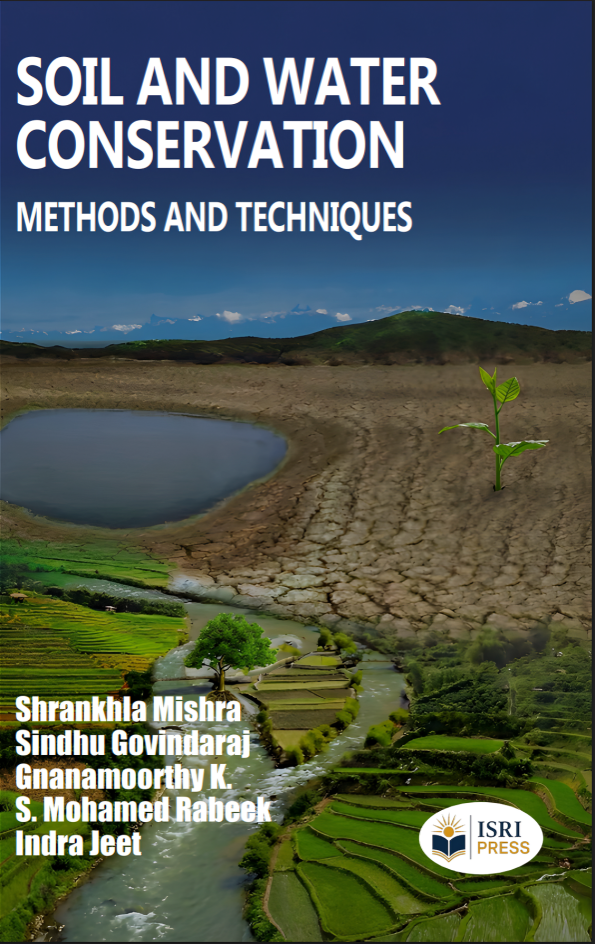
Soil and Water Conservation: Methods and Techniques
About the Book
Soil and Water Conservation: Methods and Techniques provides a comprehensive and scientific exploration of the principles, practices, and modern technologies essential for the sustainable management of soil and water resources. As global challenges such as soil degradation, land erosion, and water scarcity continue to intensify, this book presents a structured framework for strengthening environmental resilience and ensuring long-term agricultural sustainability.
The book bridges theoretical concepts with real-world application, offering an integrated understanding of soil erosion processes, watershed management, and conservation planning across diverse agro-climatic conditions. It introduces both classical approaches and modern analytical tools that enable effective assessment, prediction, and control of resource degradation.
Key areas include soil erosion dynamics, rainfall-runoff relationships, and advanced modeling techniques, along with practical conservation strategies such as contouring, terracing, mulching, agroforestry, and gully control. The text also explores integrated water resource management practices including rainwater harvesting, groundwater recharge, and micro-irrigation systems.
Special emphasis is given to watershed management, participatory approaches, and region-specific applications, particularly in ecologically sensitive and resource-constrained environments. Case-based insights and field-oriented perspectives enhance the practical relevance of the subject matter.
Designed for students, researchers, agricultural professionals, environmental planners, and policymakers, this book serves as a valuable academic resource and practical guide for sustainable land and water management.
Key Features
- Comprehensive analysis of soil erosion processes and conservation techniques
- Integration of mechanical and biological soil conservation methods
- Detailed coverage of water conservation and watershed management
- Application of modern tools and models for soil and water assessment
- Focus on climate-resilient and sustainable agricultural practices
- Practical examples and region-specific insights
Target Audience
Students, researchers, academicians, agricultural professionals, environmental scientists, and policymakers working in soil science, water resource management, and sustainable agriculture.
Keywords
Keywords: Soil Conservation, Water Management, Watershed Management, Soil Erosion, Rainwater Harvesting, Sustainable Agriculture, Climate Resilience, Soil Health, Agroforestry, Land Management
Contents
| Chapter / Section | Title | Page |
|---|---|---|
| Chapter 1 | Fundamentals of Soil and Water Conservation | 9 |
| 1.1 | Soil as a Natural Resource | 10 |
| 1.2 | Hydrological Cycle and Water Balance | 13 |
| 1.3 | Land Degradation and Desertification | 16 |
| 1.4 | Soil-Water-Plant Relationship | 19 |
| 1.5 | Causes of Soil Erosion | 22 |
| 1.6 | Importance of Conservation Practices | 24 |
| Conclusion (Chapter 1) | 27 | |
| Chapter 2 | Soil Erosion Processes and Measurement | 28 |
| 2.1 | Types of Soil Erosion | 29 |
| 2.2 | Runoff and Sediment Transport | 34 |
| 2.3 | Erosion Prediction Models | 36 |
| 2.4 | Rainfall–Runoff Relationship | 40 |
| 2.5 | Field Measurement Techniques | 44 |
| 2.6 | Soil Loss Assessment | 49 |
| Conclusion (Chapter 2) | 53 | |
| Chapter 3 | Mechanical Soil Conservation Methods | 54 |
| 3.1 | Contour Bunding | 56 |
| 3.2 | Terracing | 57 |
| 3.3 | Check Dams | 60 |
| 3.4 | Gully Control Structures | 62 |
| 3.5 | Graded Bunds | 64 |
| 3.6 | Land Leveling | 67 |
| Conclusion (Chapter 3) | 71 | |
| Chapter 4 | Biological Soil Conservation Methods | 72 |
| 4.1 | Vegetative Barriers | 73 |
| 4.2 | Agroforestry Systems | 75 |
| 4.3 | Mulching Techniques | 78 |
| 4.4 | Cover Cropping | 80 |
| 4.5 | Grassland Management | 83 |
| Conclusion (Chapter 4) | 98 | |
| Chapter 5 | Water Conservation Techniques | 100 |
| 5.1 | Rainwater Harvesting | 101 |
| 5.2 | Farm Ponds | 105 |
| 5.3 | Percolation Tanks | 110 |
| 5.4 | Groundwater Recharge Methods | 115 |
| 5.5 | Water Use Efficiency | 120 |
| Conclusion (Chapter 5) | 128 | |
| Chapter 6 | Watershed Management | 130 |
| 6.1 | Watershed Concepts | 131 |
| 6.2 | Watershed Planning | 135 |
| 6.3 | Integrated Watershed Development | 140 |
| 6.4 | Community Participation | 150 |
| 6.5 | Monitoring and Evaluation | 160 |
| Conclusion (Chapter 6) | 170 | |
| Chapter 7 | Soil Fertility and Conservation Agriculture | 176 |
| 7.1 | Soil Fertility Management | 177 |
| 7.2 | Organic Matter Management | 180 |
| 7.3 | Nutrient Conservation | 185 |
| 7.4 | Crop Rotation | 187 |
| 7.5 | Conservation Tillage | 190 |
| Conclusion (Chapter 7) | 200 | |
| Chapter 8 | Sustainable Land Use and Environmental Management | 214 |
| 8.1 | Sustainable Land Use Planning | 215 |
| 8.2 | Land Rehabilitation | 218 |
| 8.3 | Climate Change and Conservation | 220 |
| 8.4 | Environmental Impact of Land Use Change | 222 |
| Conclusion (Chapter 8) | 225 | |
| References | References & Bibliography | 227 |





Recommended Citation
APA 7th Edition