ISRI Press Header
Journals

Peer-reviewed academic journals across disciplines.

Author Books

Scholarly monographs and edited volumes.

Magazines

Professional and industry-focused publications.

Edited Book Series

Individual academic book chapters.

Explore
Browse All Publications

Explore the complete ISRI Press publication catalogue.

Submit
Submit Manuscript

Online submission for journals and books.

Author Guidelines

Formatting and ethical standards.

Editorial
Editorial Board

Meet our academic editors.

Publication Ethics

Our peer review and integrity policies.

Support
Reviewer Resources

Tools and guidance for peer reviewers.

Members
Author Membership

Benefits for contributing authors.

Editor Membership

Join ISRI editorial leadership.

Partners
Reviewer Membership

Recognition for peer reviewers.

Institutional Membership

University and library partnerships.

Benefits
Membership Benefits

Explore all professional advantages.

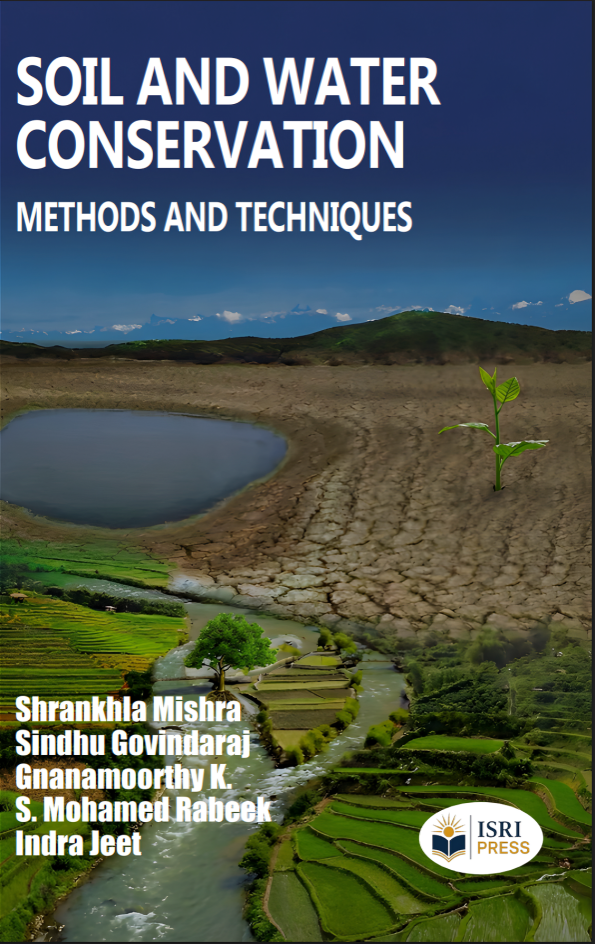
Soil and Water Conservation: Methods and Techniques

Soil and Water Conservation: Methods and Techniques

by Shrankhla Mishra iD

Shrankhla Mishra

Assistant Professor, Department of Soil and Water Conservation Engineering Rajmata Vijayaraje Scindia Krishi Vishwa Vidyalaya (RVSKVV) Gwalior, Madhya Pradesh, India
Sindhu Govindaraj iD

Sindhu Govindaraj

Assistant Professor, Department of Biotechnology Dr. M.G.R. Educational and Research Institute Chennai, Tamil Nadu, India
Gnanamoorthy K iD

Gnanamoorthy K

Assistant Professor, Department of Biotechnology Jaya College of Arts and Science Thiruninravur, Chennai, Tamil Nadu, India
S. Mohamed Rabeek iD

S. Mohamed Rabeek

Assistant Professor, PG and Research Department of Chemistry Jamal Mohamed College (Autonomous) Tiruchirappalli, Tamil Nadu, India Bio:
Indra Jeet iD

Indra Jeet

Subject Matter Specialist (Agricultural Extension) ICAR–Research Complex for Eastern Region (ICAR-RCER), Krishi Vigyan Kendra Ramgarh, Jharkhand, India
ISBN (Print): 978-93-47486-82-1
ISBN (Online): 978-93-47486-28-9
Published: 2025
Pages: 231
ABOUT THE BOOK
TABLE OF CONTENTS
AUTHOR BIOGRAPHY
CITATION

About the Book

Soil and Water Conservation: Methods and Techniques provides a comprehensive and scientific exploration of the principles, practices, and modern technologies essential for the sustainable management of soil and water resources. As global challenges such as soil degradation, land erosion, and water scarcity continue to intensify, this book presents a structured framework for strengthening environmental resilience and ensuring long-term agricultural sustainability.

The book bridges theoretical concepts with real-world application, offering an integrated understanding of soil erosion processes, watershed management, and conservation planning across diverse agro-climatic conditions. It introduces both classical approaches and modern analytical tools that enable effective assessment, prediction, and control of resource degradation.

Key areas include soil erosion dynamics, rainfall-runoff relationships, and advanced modeling techniques, along with practical conservation strategies such as contouring, terracing, mulching, agroforestry, and gully control. The text also explores integrated water resource management practices including rainwater harvesting, groundwater recharge, and micro-irrigation systems.

Special emphasis is given to watershed management, participatory approaches, and region-specific applications, particularly in ecologically sensitive and resource-constrained environments. Case-based insights and field-oriented perspectives enhance the practical relevance of the subject matter.

Designed for students, researchers, agricultural professionals, environmental planners, and policymakers, this book serves as a valuable academic resource and practical guide for sustainable land and water management.

Key Features

  • Comprehensive analysis of soil erosion processes and conservation techniques
  • Integration of mechanical and biological soil conservation methods
  • Detailed coverage of water conservation and watershed management
  • Application of modern tools and models for soil and water assessment
  • Focus on climate-resilient and sustainable agricultural practices
  • Practical examples and region-specific insights

Target Audience

Students, researchers, academicians, agricultural professionals, environmental scientists, and policymakers working in soil science, water resource management, and sustainable agriculture.

Keywords

Keywords: Soil Conservation, Water Management, Watershed Management, Soil Erosion, Rainwater Harvesting, Sustainable Agriculture, Climate Resilience, Soil Health, Agroforestry, Land Management

Contents

Chapter / Section Title Page
Chapter 1 Fundamentals of Soil and Water Conservation 9
1.1 Soil as a Natural Resource 10
1.2 Hydrological Cycle and Water Balance 13
1.3 Land Degradation and Desertification 16
1.4 Soil-Water-Plant Relationship 19
1.5 Causes of Soil Erosion 22
1.6 Importance of Conservation Practices 24
Conclusion (Chapter 1) 27
Chapter 2 Soil Erosion Processes and Measurement 28
2.1 Types of Soil Erosion 29
2.2 Runoff and Sediment Transport 34
2.3 Erosion Prediction Models 36
2.4 Rainfall–Runoff Relationship 40
2.5 Field Measurement Techniques 44
2.6 Soil Loss Assessment 49
Conclusion (Chapter 2) 53
Chapter 3 Mechanical Soil Conservation Methods 54
3.1 Contour Bunding 56
3.2 Terracing 57
3.3 Check Dams 60
3.4 Gully Control Structures 62
3.5 Graded Bunds 64
3.6 Land Leveling 67
Conclusion (Chapter 3) 71
Chapter 4 Biological Soil Conservation Methods 72
4.1 Vegetative Barriers 73
4.2 Agroforestry Systems 75
4.3 Mulching Techniques 78
4.4 Cover Cropping 80
4.5 Grassland Management 83
Conclusion (Chapter 4) 98
Chapter 5 Water Conservation Techniques 100
5.1 Rainwater Harvesting 101
5.2 Farm Ponds 105
5.3 Percolation Tanks 110
5.4 Groundwater Recharge Methods 115
5.5 Water Use Efficiency 120
Conclusion (Chapter 5) 128
Chapter 6 Watershed Management 130
6.1 Watershed Concepts 131
6.2 Watershed Planning 135
6.3 Integrated Watershed Development 140
6.4 Community Participation 150
6.5 Monitoring and Evaluation 160
Conclusion (Chapter 6) 170
Chapter 7 Soil Fertility and Conservation Agriculture 176
7.1 Soil Fertility Management 177
7.2 Organic Matter Management 180
7.3 Nutrient Conservation 185
7.4 Crop Rotation 187
7.5 Conservation Tillage 190
Conclusion (Chapter 7) 200
Chapter 8 Sustainable Land Use and Environmental Management 214
8.1 Sustainable Land Use Planning 215
8.2 Land Rehabilitation 218
8.3 Climate Change and Conservation 220
8.4 Environmental Impact of Land Use Change 222
Conclusion (Chapter 8) 225
References References & Bibliography 227
Shrankhla Mishra

Shrankhla Mishra

Shrankhla Mishra is an Assistant Professor at Rajmata Vijayaraje Scindia Krishi Vishwa Vidyalaya (RVSKVV), Gwalior, Madhya Pradesh. She earned her Ph.D. in Soil and Water Conservation Engineering from Jawaharlal Nehru Krishi Vishwa Vidyalaya, Jabalpur, in 2023, and holds an M.Tech. in the same discipline from Punjab Agricultural University, Ludhiana, where she was awarded a Junior Research Fellowship (JRF). Her research focuses on deficit irrigation and sustainable water resource management. She has been honored with the Young Scientist Award at the International Conference on Transforming Agriculture, Horticulture, and Allied Sciences and has contributed to over ten research papers, popular articles, and several training programs and conferences.

Sindhu Govindaraj

Sindhu Govindaraj

Sindhu Govindaraj is an Assistant Professor in the Department of Biotechnology at Dr. M.G.R. Educational and Research Institute, Chennai. Her teaching and research interests include nanobiotechnology, biomaterials, wound healing, phytochemistry, and natural product-based therapeutics. She has actively guided undergraduate and postgraduate students in innovative research projects and has contributed to several scientific publications and presentations at national and international platforms. Her academic work focuses on integrating modern biotechnology with traditional knowledge systems to develop sustainable healthcare solutions.

Gnanamoorthy K

Gnanamoorthy K

Gnanamoorthy K. is an Assistant Professor in the Department of Biotechnology at Jaya College of Arts and Science, Chennai, with over a decade of teaching experience in Arts & Science and Engineering disciplines. He holds M.Sc., M.Phil., and Ph.D. degrees in Biotechnology from Bharathidasan University and has demonstrated excellence in both academic and administrative roles. He has served as a placement coordinator, guiding numerous students toward successful career opportunities, and has actively mentored student research projects and dissertations. His contributions to sustainable development have been recognized through his involvement with the Institution of Green Engineers and his role as a Green Ambassador under the Energy Saving Club initiative. His research interests include microbiology, molecular biology, and applied biotechnology, with a strong focus on practical teaching methodologies and curriculum development, and his work has been acknowledged through multiple awards and consistent student academic success.

S. Mohamed Rabeek

S. Mohamed Rabeek

S. Mohamed Rabeek is an Assistant Professor in the PG and Research Department of Chemistry at Jamal Mohamed College (Autonomous), Tiruchirappalli, Tamil Nadu, with over 12 years of teaching experience. He completed his undergraduate studies in Chemistry at The New College, Chennai, and obtained his M.Sc., M.Phil., and Ph.D. degrees in Chemistry from Jamal Mohamed College. His research specialization is in synthetic organic chemistry, and he has made significant academic contributions through more than 30 publications in national and international journals, conferences, and symposiums, along with 19 national and international patents. In recognition of his excellence in teaching and research, he has received several prestigious awards, including the Best Junior Researcher Award from Jamal Research Excellence, the Eminent Scientist Award from SESD, New Delhi, and the Young Researcher Award from SIPH International and MSME.

Indra Jeet

Indra Jeet

Indra Jeet is a Subject Matter Specialist (Agricultural Extension) at ICAR–Research Complex for Eastern Region (ICAR-RCER), Krishi Vigyan Kendra, Ramgarh, Jharkhand, with over a decade of experience in agricultural extension, research, and capacity building. He has been actively engaged in promoting innovative agricultural technologies, including mulching with drip irrigation, drought-tolerant rice varieties, grafted tomato cultivation, and high-yielding crop varieties across cereals, pulses, oilseeds, and vegetables. He has also contributed to strengthening Farmers’ Producer Organizations (FPOs) and Self-Help Groups (SHGs) through initiatives such as mushroom cultivation and pulse production. His research, published in reputed journals including the Journal of Agri Search and the Journal of Community Mobilization and Sustainable Development, focuses on technology assessment, extension gaps, and communication strategies. In recognition of his contributions, he has received the Young Scientist Award (2022) and the Excellence in Extension Award (2024).

Recommended Citation

APA 7th Edition

Shrankhla Mishra, Sindhu Govindaraj, Gnanamoorthy K, S. Mohamed Rabeek, Indra Jeet (2025). Soil and Water Conservation: Methods and Techniques. ISRI Press. doi:https://doi.org/10.51470/9978-93-47486-82-1
Scroll to Top