
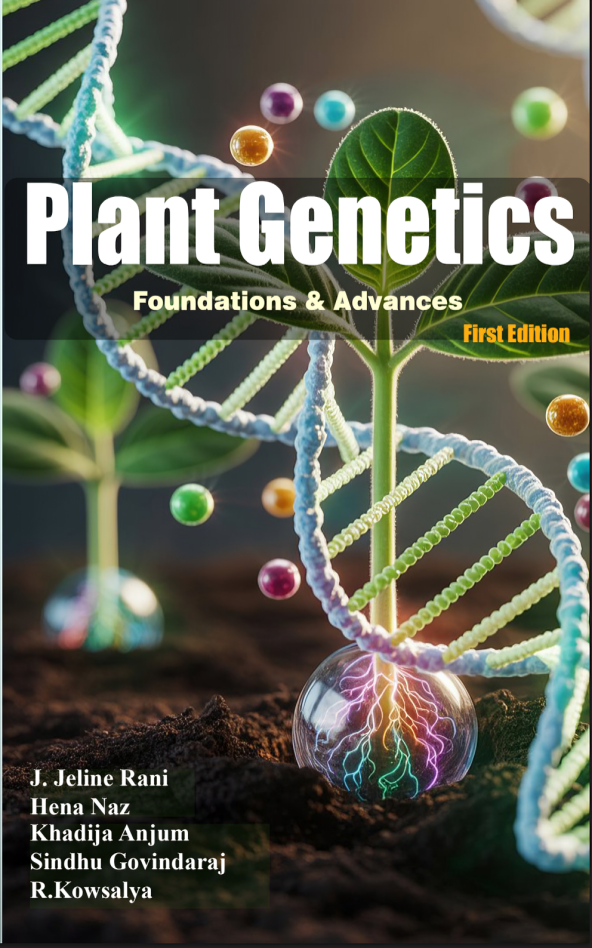
Plant Genetics Foundations and Advances
About the Book
Plant Genetics: Foundations and Advances presents a comprehensive and contemporary exploration of the genetic principles that govern plant diversity, adaptation, and evolution. The book systematically integrates classical genetic concepts with modern molecular and genomic approaches, offering a cohesive framework for understanding the genetic basis of plant systems :contentReference[oaicite:0]{index=0}.
Beginning with the historical and conceptual foundations of genetics, the text progresses through inheritance patterns, chromosomal behavior, and genetic variation, before advancing into molecular genetics, genetic mapping, and biotechnological applications. This structured progression enables readers to develop both conceptual clarity and analytical depth in plant genetics :contentReference[oaicite:1]{index=1}.
The book places strong emphasis on modern tools and technologies, including genome sequencing, molecular markers, bioinformatics, and genome editing techniques such as CRISPR. It further explores advanced domains such as genomics, transcriptomics, epigenetics, and systems biology, bridging the gap between foundational knowledge and cutting-edge research :contentReference[oaicite:2]{index=2}.
A key strength of this volume lies in its practical orientation. Chapters are enriched with real-world examples and applications in crop improvement, demonstrating how genetic principles contribute to addressing global challenges such as food security, climate change, and sustainable agriculture. The integration of theory with application ensures relevance for both academic and applied research contexts :contentReference[oaicite:3]{index=3}.
The book is designed to serve a wide audience, including undergraduate and postgraduate students, researchers, academicians, and professionals in plant breeding, biotechnology, and agricultural sciences. It aims to provide a solid foundation in plant genetics while encouraging innovation and critical thinking in plant science research.
Key Features
- Comprehensive coverage from classical Mendelian genetics to modern genomics
- Integrated approach linking foundational concepts with advanced molecular techniques
- In-depth discussion of genetic mapping, molecular markers, and genome editing
- Coverage of genomics, transcriptomics, epigenetics, and systems biology
- Application-oriented content focused on crop improvement and agricultural sustainability
- Real-world examples addressing food security and climate challenges
- Structured progression for both academic learning and research application
Target Audience
This book is intended for students, researchers, academicians, and professionals in plant genetics, biotechnology, agriculture, and related life sciences. It serves as both a foundational textbook and a reference for advanced study and research.
Keywords
Keywords: Plant Genetics, Molecular Genetics, Genomics, Genetic Mapping, Molecular Markers, Genome Editing, CRISPR, Epigenetics, Transcriptomics, Systems Biology, Plant Breeding, Crop Improvement, Agricultural Biotechnology, Food Security, Sustainable Agriculture
Contents
| Chapter | Title | Page |
|---|---|---|
| Chapter 1 | Foundations of Plant Genetics | 11 |
| 1.1 | Introduction to Plant Genetics | 12 |
| 1.2 | Historical Milestones in Genetic Discovery | 14 |
| 1.3 | Mendelian Principles and Laws of Inheritance | 18 |
| 1.4 | Chromosomal Basis of Heredity | 22 |
| 1.5 | Genetic Variation and Mutation in Plants | 28 |
| 1.6 | Significance of Genetics in Modern Agriculture | 31 |
| Chapter Summary | 39 | |
| Chapter 2 | Molecular Structure and Function of Genes | 57 |
| 2.1 | Structure and Composition of DNA and RNA | 42 |
| 2.2 | Gene Organization in Plant Genomes | 46 |
| 2.3 | DNA Replication, Transcription, and Translation | 52 |
| 2.4 | Gene Expression and Regulation in Plants | 60 |
| 2.5 | Mutation Mechanisms and DNA Repair | 69 |
| 2.6 | Molecular Markers and Genetic Polymorphism | 73 |
| Summary | 80 | |
| Chapter 3 | Genetic Mapping and Molecular Tools | 123 |
| 3.1 | Principles of Linkage and Recombination | 83 |
| 3.2 | Genetic Mapping Techniques | 85 |
| 3.3 | Quantitative Trait Loci (QTL) Mapping | 89 |
| 3.4 | Molecular Marker Systems: RFLP, AFLP, SSR, SNP | 92 |
| 3.5 | Marker-Assisted Selection and Genomic Selection | 96 |
| 3.6 | Applications in Crop Breeding and Diversity Analysis | 100 |
| Summary | 106 | |
| Chapter 4 | Genomics, Transcriptomics, and Epigenetics | 165 |
| 4.1 | Plant Genome Sequencing and Annotation | 109 |
| 4.2 | Comparative and Functional Genomics | 110 |
| 4.3 | Transcriptomics and Gene Expression Profiling | 112 |
| 4.4 | Epigenetic Mechanisms: DNA Methylation and Histone Modifications | 113 |
| 4.5 | Non-Coding RNAs and Gene Regulation | 115 |
| 4.6 | Systems Biology Approaches in Plant Genetics | 117 |
| Summary | 118 | |
| Chapter 5 | Genetic Engineering and Biotechnology Advances | 120 |
| 5.1 | Recombinant DNA Technology in Plants | 121 |
| 5.2 | Gene Cloning and Transformation Methods | 121 |
| 5.3 | Genome Editing Tools: CRISPR, TALENs, and ZFNs | 123 |
| 5.4 | Development of Transgenic and Gene-Edited Crops | 124 |
| 5.5 | Molecular Breeding and Trait Improvement | 126 |
| 5.6 | Ethical, Environmental, and Regulatory Considerations | 126 |
| Summary | 127 | |
| References | References & Bibliography | 128 |





Recommended Citation
APA 7th Edition