
ISRI Press Header
Journals

Peer-reviewed academic journals across disciplines.

Author Books

Scholarly monographs and edited volumes.

Magazines

Professional and industry-focused publications.

Edited Book Series

Individual academic book chapters.

Explore
Browse All Publications

Explore the complete ISRI Press publication catalogue.

Submit
Submit Manuscript

Online submission for journals and books.

Author Guidelines

Formatting and ethical standards.

Editorial
Editorial Board

Meet our academic editors.

Publication Ethics

Our peer review and integrity policies.

Support
Reviewer Resources

Tools and guidance for peer reviewers.

Members
Author Membership

Benefits for contributing authors.

Editor Membership

Join ISRI editorial leadership.

Partners
Reviewer Membership

Recognition for peer reviewers.

Institutional Membership

University and library partnerships.

Benefits
Membership Benefits

Explore all professional advantages.

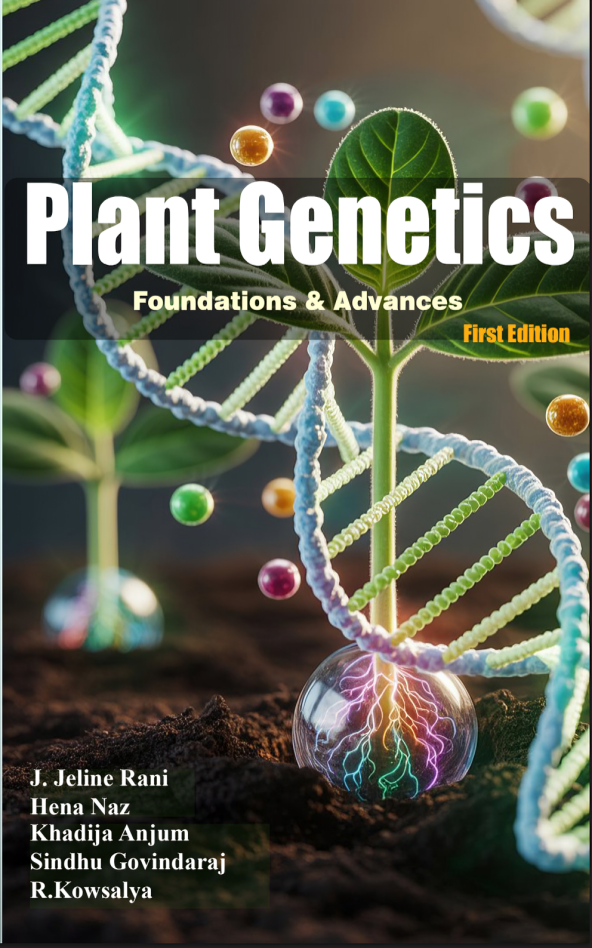
Plant Genetics Foundations and Advances

Plant Genetics Foundations and Advances

by Rani, J. Jeline iD

Rani, J. Jeline

Assistant Professor, Department of Botany, Bishop Heber College (Autonomous), Vayalur Road, Puthur, Tiruchirappalli - 620017, Tamil Nadu, India.
Naz, Hena iD

Naz, Hena

Assistant Professor, Department of Botany, Patna Women’s College (Autonomous), Bailey Road, Patna - 800001, Bihar, India
Khadija Anjum iD

Khadija Anjum

Researcher and Content Specialist, Department of Botany, Patna Women’s College (Autonomous), Bailey Road, Patna - 800001, Bihar, India
Sindhu Govindaraj iD

Sindhu Govindaraj

Assistant Professor, Department of Biotechnology, Dr. M.G.R. Educational and Research Institute (Deemed to be University), Periyar E.V.R. High Road, Maduravoyal, Chennai - 600095, Tamil Nadu, India
R. Kowsalya iD

R. Kowsalya

Dean (i/c) International Relations, Meenakshi Academy of Higher Education and Research (Deemed to be University), No. 12, Vembuliamman Koil Street, West Virugambakkam, Chennai - 600078, Tamil Nadu, India.
ISBN (Print): 978-81-993807-9-0
ISBN (Online): 978-81-993807-5-2
Published: 2025
Pages: 132
ABOUT THE BOOK
TABLE OF CONTENTS
AUTHOR BIOGRAPHY
CITATION

About the Book

Plant Genetics: Foundations and Advances presents a comprehensive and contemporary exploration of the genetic principles that govern plant diversity, adaptation, and evolution. The book systematically integrates classical genetic concepts with modern molecular and genomic approaches, offering a cohesive framework for understanding the genetic basis of plant systems :contentReference[oaicite:0]{index=0}.

Beginning with the historical and conceptual foundations of genetics, the text progresses through inheritance patterns, chromosomal behavior, and genetic variation, before advancing into molecular genetics, genetic mapping, and biotechnological applications. This structured progression enables readers to develop both conceptual clarity and analytical depth in plant genetics :contentReference[oaicite:1]{index=1}.

The book places strong emphasis on modern tools and technologies, including genome sequencing, molecular markers, bioinformatics, and genome editing techniques such as CRISPR. It further explores advanced domains such as genomics, transcriptomics, epigenetics, and systems biology, bridging the gap between foundational knowledge and cutting-edge research :contentReference[oaicite:2]{index=2}.

A key strength of this volume lies in its practical orientation. Chapters are enriched with real-world examples and applications in crop improvement, demonstrating how genetic principles contribute to addressing global challenges such as food security, climate change, and sustainable agriculture. The integration of theory with application ensures relevance for both academic and applied research contexts :contentReference[oaicite:3]{index=3}.

The book is designed to serve a wide audience, including undergraduate and postgraduate students, researchers, academicians, and professionals in plant breeding, biotechnology, and agricultural sciences. It aims to provide a solid foundation in plant genetics while encouraging innovation and critical thinking in plant science research.

Key Features

  • Comprehensive coverage from classical Mendelian genetics to modern genomics
  • Integrated approach linking foundational concepts with advanced molecular techniques
  • In-depth discussion of genetic mapping, molecular markers, and genome editing
  • Coverage of genomics, transcriptomics, epigenetics, and systems biology
  • Application-oriented content focused on crop improvement and agricultural sustainability
  • Real-world examples addressing food security and climate challenges
  • Structured progression for both academic learning and research application

Target Audience

This book is intended for students, researchers, academicians, and professionals in plant genetics, biotechnology, agriculture, and related life sciences. It serves as both a foundational textbook and a reference for advanced study and research.

Keywords

Keywords: Plant Genetics, Molecular Genetics, Genomics, Genetic Mapping, Molecular Markers, Genome Editing, CRISPR, Epigenetics, Transcriptomics, Systems Biology, Plant Breeding, Crop Improvement, Agricultural Biotechnology, Food Security, Sustainable Agriculture

Contents

Chapter Title Page
Chapter 1 Foundations of Plant Genetics 11
1.1 Introduction to Plant Genetics 12
1.2 Historical Milestones in Genetic Discovery 14
1.3 Mendelian Principles and Laws of Inheritance 18
1.4 Chromosomal Basis of Heredity 22
1.5 Genetic Variation and Mutation in Plants 28
1.6 Significance of Genetics in Modern Agriculture 31
Chapter Summary 39
Chapter 2 Molecular Structure and Function of Genes 57
2.1 Structure and Composition of DNA and RNA 42
2.2 Gene Organization in Plant Genomes 46
2.3 DNA Replication, Transcription, and Translation 52
2.4 Gene Expression and Regulation in Plants 60
2.5 Mutation Mechanisms and DNA Repair 69
2.6 Molecular Markers and Genetic Polymorphism 73
Summary 80
Chapter 3 Genetic Mapping and Molecular Tools 123
3.1 Principles of Linkage and Recombination 83
3.2 Genetic Mapping Techniques 85
3.3 Quantitative Trait Loci (QTL) Mapping 89
3.4 Molecular Marker Systems: RFLP, AFLP, SSR, SNP 92
3.5 Marker-Assisted Selection and Genomic Selection 96
3.6 Applications in Crop Breeding and Diversity Analysis 100
Summary 106
Chapter 4 Genomics, Transcriptomics, and Epigenetics 165
4.1 Plant Genome Sequencing and Annotation 109
4.2 Comparative and Functional Genomics 110
4.3 Transcriptomics and Gene Expression Profiling 112
4.4 Epigenetic Mechanisms: DNA Methylation and Histone Modifications 113
4.5 Non-Coding RNAs and Gene Regulation 115
4.6 Systems Biology Approaches in Plant Genetics 117
Summary 118
Chapter 5 Genetic Engineering and Biotechnology Advances 120
5.1 Recombinant DNA Technology in Plants 121
5.2 Gene Cloning and Transformation Methods 121
5.3 Genome Editing Tools: CRISPR, TALENs, and ZFNs 123
5.4 Development of Transgenic and Gene-Edited Crops 124
5.5 Molecular Breeding and Trait Improvement 126
5.6 Ethical, Environmental, and Regulatory Considerations 126
Summary 127
References References & Bibliography 128
 Rani, J. Jeline

Rani, J. Jeline

Rani, J. Jeline, Assistant Professor, Department of Botany, Bishop Heber College (Autonomous), Vayalur Road, Puthur, Tiruchirappalli – 620017, Tamil Nadu, India. Dr. J. Jeline Rani is an accomplished academic and researcher in Botany, currently serving as an Assistant Professor at Bishop Heber College, Trichy. She holds a B.Sc. from Lady Doak College (2000), a gold-medal-winning M.Sc. from The American College (2002), an M.Phil. from Thiagarajar College (2004), and a Ph.D. in Phytochemistry and Molecular Studies on Vanda spathulata from National College, Trichy (2025). Her research expertise lies in Phytochemistry and Molecular Biology, with a prolific record of 18 book chapters, 11 research papers, and 5 conference proceedings. Dr. Rani has earned several Best Presentation Awards at international conferences and has guided 14 M.Sc. dissertations. She successfully completed a minor research project (2023–2024) on the antidiabetic potential of Aristolochia indica L. and is an active member of professional bodies such as the Global Forum for Sustainable Rural Development (GFSRD).

Naz, Hena

Naz, Hena

Naz, Hena, Assistant Professor, Department of Botany, Patna Women’s College (Autonomous), Bailey Road, Patna – 800001, Bihar, India. Dr. Hena Naz is a dedicated academic and researcher specializing in Cytogenetics, Crop Improvement, and Nanotechnology. She holds a Master’s degree in Cytogenetics and Crop Improvement, and her doctoral research focuses on the biosynthesis of nanoparticles, assessing their cytotoxicity in plants and their antimicrobial properties against human pathogens. Dr. Naz has published numerous papers in peer-reviewed journals and has shared her findings at various national and international conferences. Beyond her research, she is deeply committed to teaching and mentoring students through Student Research Programs (SRP) and Basic Scientific Research (BSR). Her current academic interests include the synthesis of nanoparticles using wild weeds and investigating their influence on animal metabolism, fostering a comprehensive appreciation for the applications of plant science.

Khadija Anjum

Khadija Anjum

Khadija Anjum is an accomplished researcher and specialized content writer who holds a Master’s degree in Botany with a focus on Cytogenetics. Her scientific research investigates the intersection of nanotechnology and plant biology, specifically focusing on nanoparticles, plant-microbe interactions, and genetic variation. Her work explores how these factors influence disease prevalence, virulence, and pesticide resistance, contributing to more sustainable agricultural practices. Beyond the laboratory, Anjum is a creative communicator who leverages her expertise to promote public awareness on health and environmental sustainability. An avid reader and photographer, her insatiable curiosity for the natural world drives both her academic inquiries and her creative endeavors.

Sindhu Govindaraj

Sindhu Govindaraj

Govindaraj, Sindhu, Assistant Professor, Department of Biotechnology, Dr. M.G.R. Educational and Research Institute (Deemed to be University), Periyar E.V.R. High Road, Maduravoyal, Chennai – 600095, Tamil Nadu, India. Sindhu Govindaraj is an Assistant Professor and dedicated researcher whose work focuses on the intersection of nanobiotechnology and therapeutic development. Her research expertise encompasses biomaterials, wound healing, phytochemistry, and the development of natural product-based therapeutics. Throughout her academic career, she has been actively involved in mentoring undergraduate and postgraduate students in innovative research projects, fostering the next generation of biotechnologists. Govindaraj has contributed significantly to the scientific community through numerous publications and presentations at both national and international platforms. Her professional mission is dedicated to bridging modern biotechnological advancements with traditional knowledge systems to create sustainable and effective healthcare solutions.

 R. Kowsalya

R. Kowsalya

Kowsalya, R., Dean (i/c) International Relations, Meenakshi Academy of Higher Education and Research (Deemed to be University), No. 12, Vembuliamman Koil Street, West Virugambakkam, Chennai – 600078, Tamil Nadu, India. Dr. R. Kowsalya is an esteemed academic leader and researcher with extensive expertise in Environmental Biotechnology and global academic governance. Her specialized research focuses on sustainable solutions for environmental challenges, including enzyme production, the decolorization of textile dyes, and comprehensive water quality analysis. A prolific scholar, she has published numerous research papers in peer-reviewed national and international journals and has actively mentored undergraduate and postgraduate students in groundbreaking research projects.

In her administrative capacity as Dean (i/c) of International Relations, Dr. Kowsalya is instrumental in expanding the global footprint of MAHER. She oversees international faculty and student exchange programs, organizes high-level international conferences, and spearheads the establishment of strategic partnerships through Memorandums of Understanding (MoUs) with prestigious foreign universities. Her work is dedicated to fostering a collaborative global research environment and bridging the gap between academic innovation and international outreach.

Recommended Citation

APA 7th Edition

Rani, J. Jeline, Naz, Hena, Khadija Anjum, Sindhu Govindaraj, R. Kowsalya (2025). Plant Genetics Foundations and Advances. ISRI Press. doi:https://doi.org/10.51470/978-81-993807-9-0
Scroll to Top