
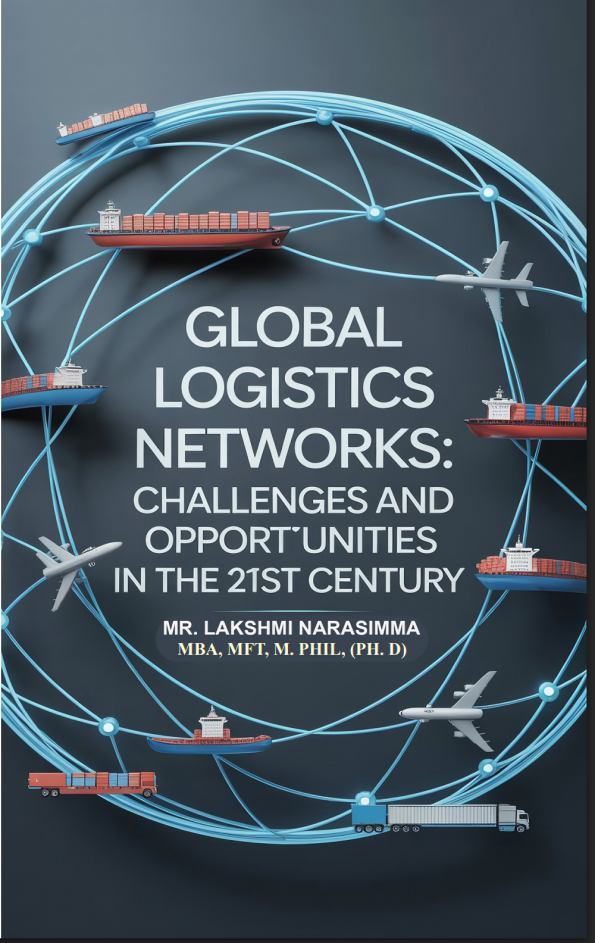
Global Logistics Networks: Challenges and Opportunities in the 21st Century
About the Book
Logistics and Supply Chain Management provides a comprehensive, structured, and industry-oriented understanding of modern logistics systems and their strategic role in organizational success. The book introduces the fundamental principles of logistics and supply chain management, highlighting their evolution, scope, and growing importance in a highly competitive and globalized business environment.
The text systematically covers core functional areas including transportation management, warehousing, inventory control, procurement, and distribution systems. It emphasizes the integration of these functions to achieve efficiency, cost optimization, and customer satisfaction. Real-world examples and practical insights are incorporated to bridge the gap between theory and application.
A key strength of this book is its focus on contemporary developments in logistics, including digital transformation, artificial intelligence, blockchain technology, and data-driven decision-making. These emerging trends are explored in detail to help readers understand how technology is reshaping supply chain operations and improving visibility, traceability, and performance.
The book also highlights sustainability and green logistics practices, addressing environmental challenges and the need for responsible supply chain management. Topics such as reverse logistics, waste reduction, and sustainable transportation are discussed to align logistics operations with global sustainability goals.
Special attention is given to the Indian and global logistics landscape, including infrastructure development, government initiatives, and industry challenges. This contextual approach enables readers to understand both domestic and international supply chain dynamics.
By combining theoretical concepts, technological advancements, and practical applications, this book serves as a valuable academic resource and professional guide. It equips readers with the knowledge and tools required to analyze, design, and manage efficient logistics and supply chain systems in today’s dynamic environment.
Key Features
- Comprehensive coverage of logistics and supply chain management concepts
- Detailed discussion of transportation, warehousing, and inventory systems
- Integration of theory with real-world industry applications
- Focus on digital logistics, AI, and emerging technologies
- Coverage of sustainability and green logistics practices
- Insights into Indian and global logistics frameworks
- Structured content for academic and professional learning
Target Audience
This book is designed for undergraduate and postgraduate students, management professionals, logistics practitioners, researchers, and academicians. It is particularly useful for individuals seeking to develop a strong foundation and practical understanding of logistics and supply chain management.
Keywords
Keywords: Logistics Management, Supply Chain Management, Transportation, Warehousing, Inventory Control, Procurement, Distribution Systems, Digital Logistics, Artificial Intelligence, Blockchain, Green Logistics, Sustainability
Contents
| Chapter | Title | Page |
|---|---|---|
| Chapter 1 | Introduction to Logistics and Supply Chain Management | 11 |
| 1.1 | Concept and Scope of Logistics | 12 |
| 1.2 | Evolution of Logistics Management | 14 |
| 1.3 | Components of Supply Chain | 18 |
| 1.4 | Role of Logistics in Business Strategy | 22 |
| 1.5 | Logistics vs Supply Chain Management | 26 |
| 1.6 | Global Logistics Trends | 30 |
| Chapter Summary | 35 | |
| Chapter 2 | Transportation Management | 57 |
| 2.1 | Modes of Transportation | 38 |
| 2.2 | Transportation Costing and Pricing | 42 |
| 2.3 | Route Planning and Optimization | 46 |
| 2.4 | Freight Management Systems | 50 |
| 2.5 | International Transportation | 54 |
| 2.6 | Green Transportation Practices | 56 |
| Summary | 60 | |
| Chapter 3 | Warehousing and Inventory Management | 123 |
| 3.1 | Functions of Warehousing | 63 |
| 3.2 | Types of Warehouses | 66 |
| 3.3 | Inventory Control Techniques | 70 |
| 3.4 | Economic Order Quantity (EOQ) | 74 |
| 3.5 | Warehouse Layout and Design | 78 |
| 3.6 | Automation in Warehousing | 82 |
| Summary | 88 | |
| Chapter 4 | Procurement and Distribution Management | 165 |
| 4.1 | Procurement Processes | 91 |
| 4.2 | Supplier Selection and Evaluation | 95 |
| 4.3 | Distribution Network Design | 99 |
| 4.4 | Channel Management | 103 |
| 4.5 | Last-Mile Delivery Challenges | 107 |
| 4.6 | Reverse Logistics | 110 |
| Summary | 114 | |
| Chapter 5 | Digital Logistics and Future Trends | 200 |
| 5.1 | Role of Technology in Logistics | 118 |
| 5.2 | Artificial Intelligence and Automation | 122 |
| 5.3 | Blockchain in Supply Chain | 126 |
| 5.4 | Internet of Things (IoT) Applications | 130 |
| 5.5 | Data Analytics in Logistics | 134 |
| 5.6 | Sustainable and Smart Logistics | 138 |
| Summary | 142 | |
| References | References & Bibliography | 145 |

Recommended Citation
APA 7th Edition