
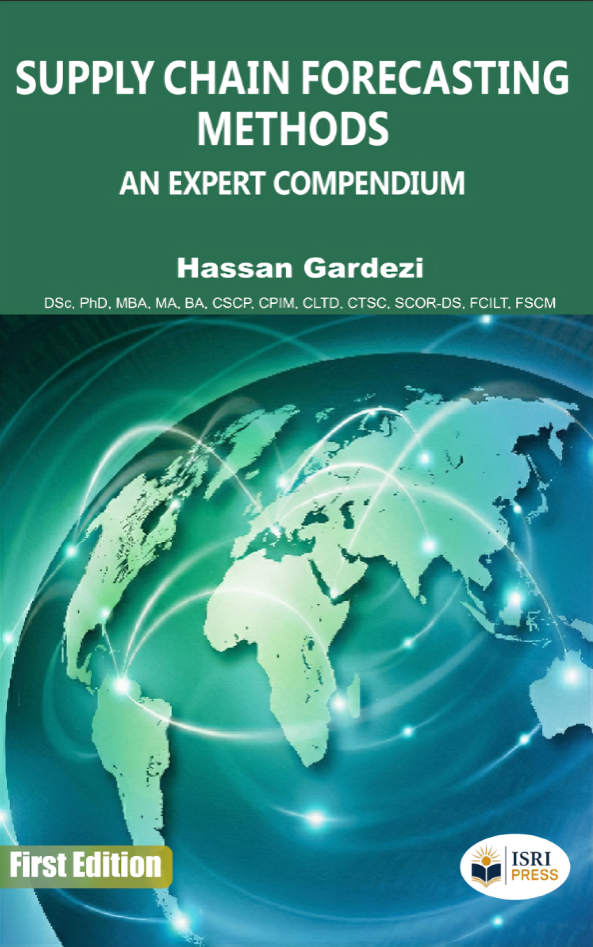
Supply Chain Forecasting Methods: An Expert Compendium
About the Book
Supply Chain Forecasting Methods: An Expert Compendium provides a comprehensive and practical guide to modern forecasting techniques used in supply chain decision-making. The book bridges the gap between traditional statistical forecasting and advanced data-driven methods, offering a structured approach to understanding demand patterns, uncertainty, and predictive modeling in complex supply chain environments.
The book begins with foundational quantitative forecasting techniques such as moving averages, exponential smoothing, and time series models including ARIMA and its variants. These methods establish the core principles of forecasting by leveraging historical data patterns such as trend, seasonality, and randomness.
It further explores causal and qualitative forecasting approaches, including regression models, Delphi methods, and market research techniques, enabling readers to incorporate external drivers, expert judgment, and customer insights into forecasting processes.
A key strength of this book lies in its focus on supply chain–specific forecasting challenges such as intermittent demand, demand variability, and multi-echelon inventory systems. Advanced methods like Croston’s model, bootstrapping, and pipeline forecasting are presented to address real-world complexities. For example, pipeline forecasting significantly improves inventory accuracy, reduces stock-outs, and enhances working capital planning :contentReference[oaicite:0]{index=0}.
The book also emphasizes probabilistic forecasting and uncertainty quantification, highlighting the importance of prediction intervals, simulation techniques, and risk-based planning. It demonstrates how ignoring uncertainty can lead to poor inventory decisions and service level failures :contentReference[oaicite:1]{index=1}.
In addition, modern advancements such as machine learning, hybrid forecasting systems, and graph-based models are discussed, showcasing how organizations can leverage data, technology, and analytics to improve forecast accuracy and operational performance. The book ultimately equips readers with both theoretical knowledge and practical tools required to design robust forecasting systems in dynamic and uncertain supply chain environments.
Key Features
- Comprehensive coverage of classical and modern forecasting techniques
- Integration of time series, causal, and qualitative forecasting methods
- Detailed focus on supply chain–specific forecasting challenges and solutions
- Inclusion of intermittent demand models such as Croston and TSB methods
- Application of probabilistic forecasting and uncertainty quantification techniques
- Use of simulation, scenario planning, and risk-based forecasting approaches
- Coverage of machine learning, hybrid models, and advanced analytics
- Practical insights into ERP integration and real-world forecasting systems
Target Audience
This book is intended for students, researchers, supply chain professionals, demand planners, data analysts, operations managers, and academicians. It is particularly valuable for those seeking to develop expertise in forecasting techniques and apply them to improve supply chain efficiency, planning accuracy, and decision-making under uncertainty.
Keywords
Keywords: Demand Forecasting, Supply Chain Forecasting, Time Series Analysis, ARIMA, Exponential Smoothing, Regression Models, Delphi Method, Intermittent Demand, Croston Method, Probabilistic Forecasting, Prediction Intervals, Machine Learning, Scenario Planning, Inventory Forecasting, Supply Chain Analytics
Contents
| Chapter | Title | Page |
|---|---|---|
| CHAPTER 1 | FOUNDATIONAL QUANTITATIVE (TIME SERIES) FORECASTING METHODS | 11 |
| ABSTRACT | 12 | |
| 1.1 | SIMPLE MOVING AVERAGE | 12 |
| 1.2 | WEIGHTED MOVING AVERAGE | 14 |
| 1.3 | SINGLE EXPONENTIAL SMOOTHING | 15 |
| 1.4 | HOLT’S LINEAR TREND METHOD | 17 |
| 1.5 | HOLT-WINTERS METHOD | 18 |
| 1.6 | CLASSICAL TIME SERIES DECOMPOSITION | 20 |
| 1.7 | ARIMA MODELS | 21 |
| 1.8 | SARIMA MODELS | 23 |
| 1.9 | SARIMAX MODELS | 24 |
| CONCLUSION | 26 | |
| CHAPTER 2 | CAUSAL (EXPLANATORY) FORECASTING METHODS | 27 |
| ABSTRACT | 28 | |
| 2.1 | LINEAR REGRESSION | 28 |
| 2.2 | MULTIPLE REGRESSION | 30 |
| 2.3 | LOGISTIC REGRESSION | 33 |
| 2.4 | ECONOMETRIC MODELS | 36 |
| 2.5 | DYNAMIC REGRESSION MODELS | 38 |
| CONCLUSION | 41 | |
| CHAPTER 3 | ADVANCED STATISTICAL AND MACHINE LEARNING FORECASTING METHODS | 42 |
| ABSTRACT | 43 | |
| 3.1 | MACHINE LEARNING REGRESSION MODELS | 44 |
| 3.2 | ARTIFICIAL NEURAL NETWORKS | 46 |
| 3.3 | RECURRENT NEURAL NETWORKS | 49 |
| 3.4 | LONG SHORT-TERM MEMORY NETWORKS | 51 |
| 3.5 | SUPPORT VECTOR REGRESSION | 53 |
| 3.6 | PROPHET | 56 |
| 3.7 | ENSEMBLE FORECASTING METHODS | 59 |
| 3.8 | M5 COMPETITION-INSPIRED METHODOLOGIES | 61 |
| CONCLUSION | 65 | |
| CHAPTER 4 | INVENTORY AND SUPPLY CHAIN–SPECIFIC FORECASTING METHODS | 67 |
| ABSTRACT | 68 | |
| 4.1 | CROSTON’S METHOD | 68 |
| 4.2 | TSB METHOD | 71 |
| 4.3 | BOOTSTRAPPING TECHNIQUES | 73 |
| 4.4 | DISTRIBUTION REQUIREMENTS PLANNING | 76 |
| 4.5 | PIPELINE FORECASTING | 79 |
| CONCLUSION | 83 | |
| CHAPTER 5 | JUDGMENTAL AND QUALITATIVE FORECASTING METHODS | 85 |
| ABSTRACT | 85 | |
| 5.1 | SALES FORCE COMPOSITE | 85 |
| 5.2 | EXECUTIVE OPINION AND DELPHI METHOD | 90 |
| 5.3 | MARKET RESEARCH-BASED FORECASTING | 94 |
| 5.4 | HISTORICAL ANALOGY | 97 |
| 5.5 | SCENARIO PLANNING | 101 |
| CONCLUSION | 105 | |
| CHAPTER 6 | COLLABORATIVE AND MARKET SENSING FORECASTING METHODS | 107 |
| ABSTRACT | 107 | |
| 6.1 | COLLABORATIVE PLANNING, FORECASTING, AND REPLENISHMENT | 107 |
| 6.2 | DEMAND SENSING | 111 |
| 6.3 | CONSUMPTION-BASED FORECASTING | 115 |
| 6.4 | VENDOR MANAGED INVENTORY FORECASTING | 118 |
| CONCLUSION | 121 | |
| CHAPTER 7 | NEW PRODUCT FORECASTING METHODS | 123 |
| ABSTRACT | 123 | |
| 7.1 | BASS DIFFUSION MODEL | 124 |
| 7.2 | PRE-LAUNCH MARKET TESTING | 127 |
| 7.3 | EARLY SALES AND LIKE-ITEM ANALYSIS | 131 |
| CONCLUSION | 136 | |
| CHAPTER 8 | PROBABILISTIC AND UNCERTAINTY-FOCUSED FORECASTING METHODS | 138 |
| ABSTRACT | 138 | |
| 8.1 | QUANTILE REGRESSION | 138 |
| 8.2 | MONTE CARLO SIMULATION | 142 |
| 8.3 | BAYESIAN FORECASTING | 146 |
| 8.4 | PREDICTION INTERVALS | 149 |
| CONCLUSION | 153 | |
| CHAPTER 9 | AI-DRIVEN AND EMERGING FORECASTING METHODS | 155 |
| ABSTRACT | 155 | |
| 9.1 | DEEP LEARNING HYBRID MODELS | 156 |
| 9.2 | TRANSFORMER-BASED MODELS | 162 |
| 9.3 | GRAPH NEURAL NETWORKS | 167 |
| 9.4 | CAUSAL AI MODELS | 171 |
| 9.5 | GENERATIVE AI FOR FORECASTING | 175 |
| 9.6 | DIGITAL TWIN (DEMAND TWIN) | 179 |
| 9.7 | REINFORCEMENT LEARNING | 184 |
| CHAPTER 10 | SECTOR-SPECIFIC AND SPECIALIZED FORECASTING METHODS | 186 |
| ABSTRACT | 193 | |
| 10.1 | PARTS AND SERVICE LIFECYCLE FORECASTING | 193 |
| 10.2 | COMMODITY PRICE FORECASTING | 197 |
| 10.3 | PROMOTION AND EVENT LIFT MODELING | 202 |
| 10.4 | MARKDOWN AND CLEARANCE OPTIMIZATION | 206 |
| 10.5 | CLOSED-LOOP MRP/ERP FORECASTING | 210 |
| CONCLUSION | 215 | |
| REFERENCES | 217 |

Recommended Citation
APA 7th Edition